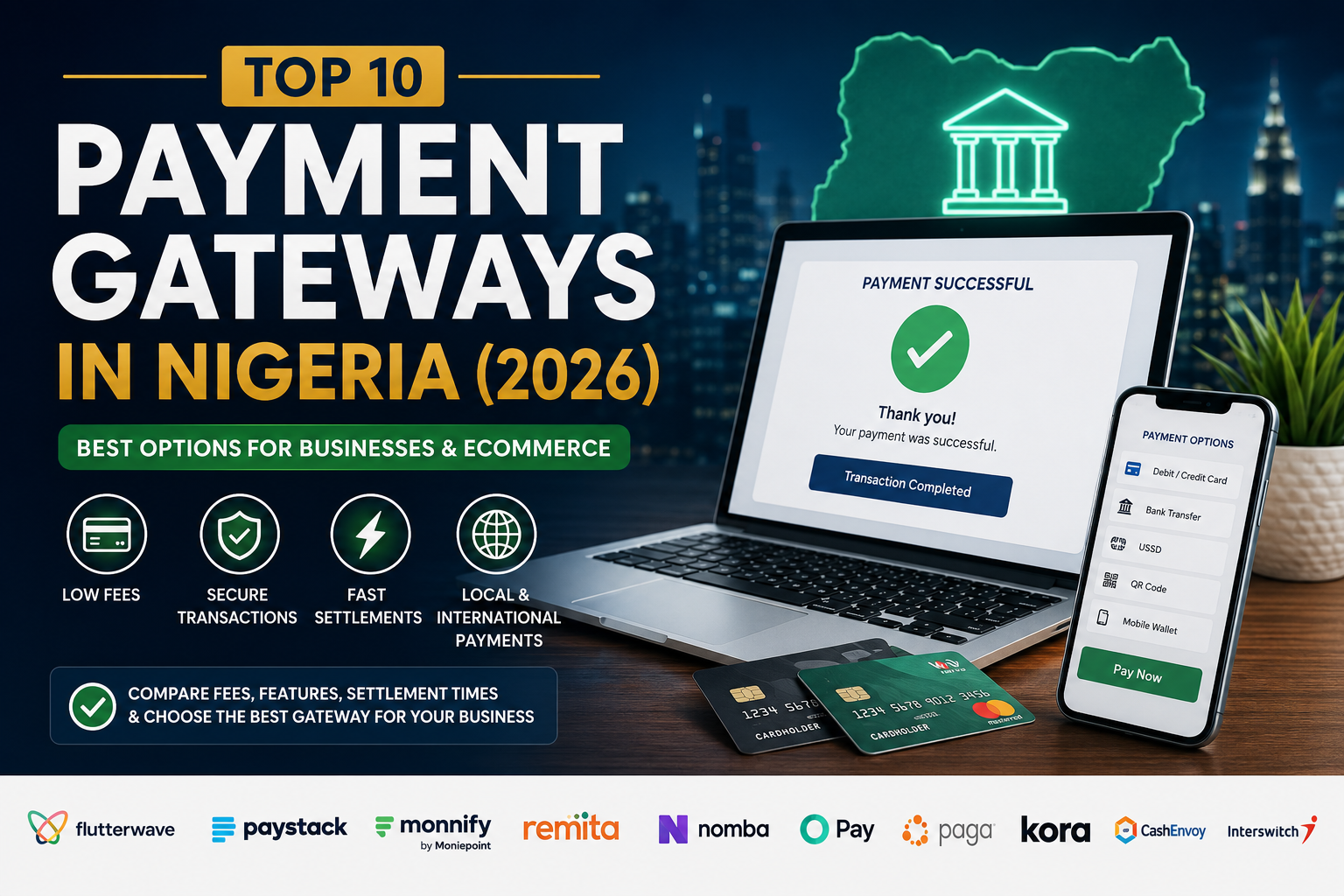
Best Payment Gateways in Nigeria (2026): Top 10 Online Payment Platforms Compared
If you want to accept online payments in Nigeria, choosing the right payment gateway is one of the most important decisions you’ll make. Whether you run an eCommerce store, SaaS business, school, church, NGO, subscription platform, or service-based company, your payment gateway directly affects your customers’ experience, your conversion rate, and ultimately your revenue.
With dozens of payment gateways in Nigeria available today, it can be difficult to know which platform offers the best combination of low fees, fast settlements, reliable uptime, and easy integration.
Some gateways are designed for small businesses that only accept local payments, while others support international transactions, recurring billing, virtual accounts, split payments, and multi-currency processing.
In this comprehensive 2026 guide, we’ll compare the best payment gateways in Nigeria, including transaction fees, supported payment methods, payout times, integrations, security, and the types of businesses they’re best suited for.
Whether you’re looking for:
- the best payment gateway in Nigeria for your online store,
- an international payment gateway in Nigeria that accepts foreign payments,
- reliable payment platforms in Nigeria for your startup,
- or a complete list of payment gateways in Nigeria,
this guide will help you make an informed decision.
What You’ll Learn
By the end of this guide, you’ll understand:
- The best online payment gateways in Nigeria for different business types.
- The pros and cons of each payment processor.
- Current transaction fees and settlement times.
- Which gateways support international payments.
- Which platforms integrate with WordPress, WooCommerce, Shopify, Laravel, and custom websites.
- How to choose the right payment gateway for your business.
- Common mistakes to avoid before integrating a payment processor.
Whether you’re launching your first online business or looking to switch providers, this guide will help you select the right payment solution with confidence.
Why Choosing the Right Payment Gateway Matters
A payment gateway does much more than process payments.
It directly influences:
- Customer trust
- Checkout abandonment rates
- Payment success rates
- Cash flow
- Security
- International expansion
- Business growth
Imagine a customer who has already added products to their cart but experiences repeated payment failures during checkout. In many cases, they won’t try again—they’ll simply buy from a competitor.
On the other hand, a fast, secure, and reliable payment gateway creates a smooth checkout experience that increases conversions and encourages repeat purchases.
That’s why choosing the right online payment platform in Nigeria isn’t just a technical decision—it’s a business decision that can significantly impact your sales.
What Is a Payment Gateway?
A payment gateway is a secure technology that allows businesses to accept online payments from customers through their website, mobile app, or checkout page.
It acts as the bridge between your customer, your website, your bank, and the customer’s bank, ensuring that every transaction is encrypted, verified, and processed safely.
Whenever someone pays for a product or service online using a debit card, credit card, bank transfer, USSD, QR code, digital wallet, Apple Pay, Google Pay, or another payment method, a payment gateway works behind the scenes to authorize the payment and transfer the funds securely.
Without a payment gateway, businesses would not be able to receive online payments automatically.
How Does a Payment Gateway Work?
Although the process happens within a few seconds, several steps take place every time a customer makes a payment.
Here’s a simplified breakdown:
Step 1: Customer Initiates Payment
The customer selects a product or service and clicks Pay Now on your website or mobile application.
Step 2: Payment Details Are Encrypted
The payment gateway securely encrypts the customer’s payment information before sending it to the payment processor.
This protects sensitive financial data from fraud and cyberattacks.
Step 3: Bank Verification
The customer’s bank verifies:
- Available funds
- Card validity
- Security checks
- Fraud detection
The bank then approves or declines the transaction.
Step 4: Payment Confirmation
If approved, the payment gateway immediately notifies both the customer and your website that the transaction was successful.
If declined, the customer receives an error message and can choose another payment method.
Step 5: Settlement
After approval, the funds are transferred to your merchant account according to the payment provider’s settlement schedule.
Some payment processors in Nigeria settle payments instantly, while others process payouts within 24 hours or a few business days.
Payment Gateway vs Payment Processor
Many people use these terms interchangeably, but they aren’t exactly the same.
| Payment Gateway | Payment Processor |
|---|---|
| Collects and securely transmits payment information. | Processes the transaction between the customer’s bank and the merchant’s bank. |
| Encrypts customer payment data. | Moves funds after payment approval. |
| Integrates with your website or app. | Works behind the scenes with banks and card networks. |
Fortunately, most modern payment platforms in Nigeria combine both services into a single solution, so businesses don’t need to manage them separately.
Payment Methods Supported by Nigerian Payment Gateways
The best online payment gateways in Nigeria support multiple payment options, making it easier for customers to complete purchases using their preferred method.
Common payment methods include:
Debit & Credit Cards
Customers can pay using:
- Verve
- Visa
- Mastercard
- American Express (supported by some gateways)
Card payments remain one of the most popular payment methods for Nigerian eCommerce businesses.
Bank Transfers
Instant bank transfers have become one of the fastest-growing payment methods in Nigeria.
Many payment gateways now generate dedicated virtual accounts, allowing customers to complete transfers without uploading payment receipts.
USSD Payments
USSD allows customers to complete payments directly from their mobile phones without needing internet access.
This method is particularly useful for customers in areas with limited internet connectivity.
Mobile Wallets
Some gateways support digital wallets, allowing users to pay directly from their wallet balances.
Examples include wallet-based fintech platforms and mobile money services.
QR Code Payments
Customers simply scan a QR code using their banking app or mobile wallet to complete a payment quickly and securely.
International Payments
Several international payment gateways in Nigeria allow businesses to receive payments from customers abroad.
These gateways typically support:
- USD
- GBP
- EUR
- CAD
- Other major international currencies
This is particularly valuable for freelancers, exporters, SaaS businesses, digital agencies, and companies serving international clients.
Why Businesses Need a Payment Gateway
Whether you’re selling physical products, digital downloads, subscriptions, or professional services, a payment gateway simplifies the entire payment process.
Some of the biggest benefits include:
Faster Payments
Customers can pay instantly without waiting for manual confirmation.
Improved Customer Experience
A simple checkout process reduces abandoned carts and increases completed purchases.
Better Security
Leading payment gateways comply with international security standards and use encryption to protect customer information.
Automated Payment Confirmation
Successful payments are confirmed automatically, reducing manual work for business owners.
Business Growth
By accepting multiple payment methods—including international payments—you can reach more customers and increase sales.
Who Needs a Payment Gateway?
Almost every business that receives money online can benefit from a payment gateway.
Examples include:
- eCommerce stores
- Schools and educational platforms
- Churches and ministries
- NGOs and charities
- Hotels and hospitality businesses
- Real estate companies
- Healthcare providers
- Professional service firms
- Digital agencies
- Freelancers
- Subscription-based businesses
- Software (SaaS) companies
If customers can pay you online, you need a reliable payment gateway.
What Makes a Great Payment Gateway?
Not all payment gateways offer the same features.
When comparing the best payment gateway in Nigeria, consider factors such as:
- High transaction success rates
- Fast settlement times
- Competitive transaction fees
- Strong security and fraud protection
- Easy integration with your website
- Reliable customer support
- Support for local and international payments
- Multiple payment methods
- Developer-friendly APIs
- Excellent uptime and reliability
The right payment gateway should not only process payments but also support your business as it grows.
Up Next
Now that you understand how payment gateways work, it’s time to compare the top 10 payment gateways in Nigeria.
In the next section, we’ll review each platform in detail, including transaction fees, features, supported payment methods, integrations, settlement times, and the types of businesses they’re best suited for.
Top 10 Payment Gateways in Nigeria (2026)
With dozens of payment gateways in Nigeria available today, choosing the right one can be challenging. Some platforms focus on small businesses and startups, while others are built for enterprise companies, fintechs, and businesses that process high transaction volumes.
To help you decide, we’ve compared the top 10 payment gateways in Nigeria based on:
- Transaction fees
- Settlement speed
- Supported payment methods
- Ease of integration
- International payment support
- Security
- Customer support
- Popularity among Nigerian businesses
1. Flutterwave
One of Africa’s largest fintech companies, Flutterwave is widely regarded as one of the best payment gateways in Nigeria. It supports businesses in more than 30 African countries and enables merchants to accept payments from customers worldwide.
Best For
- eCommerce stores
- SaaS companies
- Startups
- SMEs
- International businesses
Key Features
- Card payments
- Bank transfers
- USSD
- Apple Pay
- Google Pay
- Mobile wallets
- Recurring payments
- Payment links
- Virtual accounts
- Multi-currency payments
Pros
- Excellent developer API
- Supports international payments
- WooCommerce, Shopify and WordPress integration
- Strong documentation
- Reliable uptime
Cons
- International transaction fees are higher.
- Verification can take time for some businesses.
Overall Rating: ⭐⭐⭐⭐⭐ (5/5)
2. Paystack
Acquired by Stripe, Paystack remains one of the most popular online payment platforms in Nigeria.
Its clean dashboard, excellent documentation, and simple integration make it a favorite among developers and small businesses.
Best For
- Small businesses
- Startups
- Agencies
- Subscription businesses
- Online stores
Key Features
- Card payments
- Bank transfers
- Recurring billing
- Payment pages
- Payment links
- Invoicing
- Virtual accounts
Pros
- Very easy to integrate
- Excellent reporting dashboard
- Great documentation
- Reliable customer experience
- Strong WordPress support
Cons
- Supports fewer African countries than Flutterwave.
Overall Rating: ⭐⭐⭐⭐⭐ (5/5)
3. Monnify
Developed by Moniepoint, Monnify has become one of the fastest-growing payment processors in Nigeria.
It is particularly popular among fintech companies and businesses that rely heavily on bank transfers.
Best For
- Fintech startups
- Schools
- Utility companies
- Agencies
- B2B businesses
Key Features
- Instant virtual accounts
- Bank transfers
- Card payments
- Bulk payments
- Automated reconciliation
- API integrations
Pros
- Excellent bank transfer success rate
- Competitive transaction fees
- Fast settlements
- Reliable APIs
Cons
- Fewer eCommerce features compared to Paystack and Flutterwave.
Overall Rating: ⭐⭐⭐⭐☆ (4.8/5)
4. Remita
Remita is one of Nigeria’s oldest and most trusted payment platforms.
It is widely used by government agencies, universities, and large organizations.
Best For
- Government agencies
- Educational institutions
- Large organizations
- Payroll systems
Key Features
- Card payments
- Bank transfers
- USSD
- Salary processing
- Bulk collections
Pros
- Highly trusted
- Strong enterprise features
- Supports multiple payment channels
Cons
- Interface feels less modern than newer competitors.
Overall Rating: ⭐⭐⭐⭐☆ (4.6/5)
5. Interswitch WebPAY
Interswitch pioneered electronic payments in Nigeria and continues to power thousands of businesses across Africa.
Its WebPAY solution is ideal for organizations requiring secure, enterprise-grade payment infrastructure.
Best For
- Banks
- Enterprises
- Large retailers
- Financial institutions
Key Features
- Card processing
- Bank transfers
- Enterprise APIs
- Fraud management
- Multi-channel payments
Pros
- Long-standing reputation
- High security standards
- Excellent enterprise support
Cons
- Integration can be more technical than newer platforms.
Overall Rating: ⭐⭐⭐⭐☆ (4.5/5)
6. OPay
Originally known for its consumer wallet, OPay has expanded into one of the leading payment platforms in Nigeria.
It provides businesses with fast collections through transfers, QR codes, POS terminals, and merchant solutions.
Best For
- Retail businesses
- Restaurants
- SMEs
- Physical stores
Key Features
- QR payments
- Wallet payments
- POS terminals
- Bank transfers
- Merchant accounts
Pros
- Large customer base
- Fast payouts
- Competitive fees
Cons
- Fewer developer tools than Flutterwave or Paystack.
Overall Rating: ⭐⭐⭐⭐☆ (4.5/5)
7. Paga
Paga focuses on financial inclusion by enabling businesses to receive payments from both banked and unbanked customers.
It has built a large nationwide agent network across Nigeria.
Best For
- SMEs
- NGOs
- Rural businesses
- Financial service providers
Key Features
- Mobile wallet
- Agent banking
- Merchant collections
- Bill payments
- API integration
Pros
- Strong nationwide reach
- Easy customer onboarding
- Mobile-friendly
Cons
- Limited international payment capabilities.
Overall Rating: ⭐⭐⭐⭐☆ (4.4/5)
8. Kora
Kora has quickly gained popularity among startups looking for modern APIs and cross-border payment solutions.
Best For
- SaaS businesses
- Developers
- Startups
- International companies
Key Features
- Virtual accounts
- Cross-border payments
- APIs
- Bank transfers
- Card processing
Pros
- Excellent API documentation
- Developer-focused
- Strong international capabilities
Cons
- Smaller ecosystem compared to Flutterwave and Paystack.
Overall Rating: ⭐⭐⭐⭐☆ (4.4/5)
9. Nomba
Formerly known as Kudi, Nomba has evolved into one of Nigeria’s leading payment and business banking platforms. Beyond payment processing, Nomba offers POS solutions, business accounts, payment links, invoicing, and merchant management tools, making it a popular choice for small and medium-sized businesses.
Best For
- SMEs
- Retail businesses
- Restaurants
- Supermarkets
- Service providers
- Businesses with physical locations
Key Features
- Card payments
- Bank transfers
- Virtual accounts
- POS terminals
- Payment links
- Business banking
- QR code payments
- Invoicing
- Merchant dashboard
Pros
- Excellent all-in-one business platform
- Reliable POS ecosystem
- Fast settlements
- Easy onboarding
- Strong merchant support
- Growing nationwide presence
Cons
- Fewer advanced developer APIs than Flutterwave and Paystack.
- Better suited for merchants than highly customized fintech applications.
Overall Rating: ⭐⭐⭐⭐☆ (4.7/5)
10. CashEnvoy
CashEnvoy is one of Nigeria’s earliest online payment providers and continues to serve businesses looking for affordable payment processing.
Best For
- Small businesses
- SMEs
- WordPress websites
Key Features
- Card payments
- Merchant accounts
- Website integration
- Payment processing
Pros
- Easy setup
- Affordable pricing
- Long-standing presence
Cons
- Fewer advanced features compared to newer platforms.
Overall Rating: ⭐⭐⭐⭐☆ (4.1/5)
Quick Comparison Table
| Payment Gateway | Best For | International Payments | WordPress Integration | Overall Rating |
|---|---|---|---|---|
| Flutterwave | eCommerce & SaaS | ✅ Yes | ✅ Excellent | ⭐⭐⭐⭐⭐ |
| Paystack | SMEs & Startups | ✅ Yes | ✅ Excellent | ⭐⭐⭐⭐⭐ |
| Monnify | Fintech & B2B | Limited | ✅ Yes | ⭐⭐⭐⭐☆ |
| Remita | Government & Enterprise | Limited | Moderate | ⭐⭐⭐⭐☆ |
| Interswitch | Enterprise | Limited | Moderate | ⭐⭐⭐⭐☆ |
| OPay | Retail Businesses | No | Limited | ⭐⭐⭐⭐☆ |
| Paga | SMEs | Limited | Moderate | ⭐⭐⭐⭐☆ |
| Kora | Developers | ✅ Yes | Excellent | ⭐⭐⭐⭐☆ |
| Nomba | Freelancers | ✅ Yes | Good | ⭐⭐⭐⭐☆ |
| CashEnvoy | Small Businesses | Limited | Good | ⭐⭐⭐⭐☆ |
Which Payment Gateway Is the Best?
There’s no single payment gateway that’s perfect for every business.
- Flutterwave is an excellent all-round choice for businesses that need local and international payment support.
- Paystack is ideal for startups, agencies, and businesses looking for simple integration and a polished user experience.
- Monnify excels in bank transfers and virtual accounts.
- Kora is a strong option for developers building products for multiple African markets.
- OPay is well-suited to offline retailers and businesses with a physical presence.
The best choice ultimately depends on your business model, target audience, transaction volume, and the features you need.
Up Next
In the next section, we’ll compare transaction fees, settlement times, supported payment methods, and integrations side by side, making it easier to choose the best payment gateway for your specific business.
Payment Gateway Comparison: Fees, Settlement Times & Features (2026)
Now that you’ve seen the leading payment gateways in Nigeria, let’s compare them side by side. While features are important, factors like transaction fees, payout speed, supported payment methods, and ease of integration can significantly impact your business’s profitability and customer experience.
The table below provides a quick overview of the most important differences between the leading online payment platforms in Nigeria.
Note: Transaction fees and features may change over time. Always verify the latest pricing on each provider’s official website before making a decision.
Comparison Table
| Payment Gateway | Local Transaction Fee* | International Payments | Settlement Time | WordPress/WooCommerce | Payment Methods | Best For |
|---|---|---|---|---|---|---|
| Flutterwave | From 1.4% | ✅ Yes | Within 24 hours | ✅ Excellent | Cards, Bank Transfer, USSD, Apple Pay, Google Pay, Mobile Wallets | eCommerce, SaaS, Growing Businesses |
| Paystack | From 1.5% + applicable charges | ✅ Yes | Same day / Next business day | ✅ Excellent | Cards, Transfers, USSD, Payment Links | SMEs, Startups |
| Monnify | From 1.3% | Limited | Instant / Next Day | ✅ Good | Bank Transfers, Cards, Virtual Accounts | Fintech, B2B |
| Remita | Varies | Limited | Next Business Day | Good | Cards, Transfers, USSD | Government & Enterprise |
| Nomba | Varies | Limited | Fast Settlement | Good | Cards, Transfers, POS, QR | Retail & SMEs |
| Interswitch WebPAY | Varies | Limited | Next Business Day | Moderate | Cards, Transfers | Large Businesses |
| OPay | Competitive | No | Instant | Limited | Wallet, Transfers, QR, POS | Physical Businesses |
| Paga | Competitive | Limited | Fast Settlement | Moderate | Wallet, Transfers, USSD | SMEs & NGOs |
| Kora | Custom Pricing Available | ✅ Yes | Fast | ✅ Excellent | Cards, Transfers, Virtual Accounts | Developers & Global Businesses |
| CashEnvoy | Varies | Limited | Next Business Day | Good | Cards, Transfers | Small Businesses |
*Fees shown are typical starting rates and may vary depending on transaction type, business category, negotiated pricing, and payment method.
Which Payment Gateway Offers the Lowest Fees?
If keeping transaction costs low is your top priority, several payment processors in Nigeria offer competitive pricing.
Generally:
- Monnify is known for its affordable bank transfer pricing and low transaction caps.
- OPay offers competitive merchant rates for retail businesses.
- Flutterwave remains competitively priced while offering a broader feature set.
- Paystack provides excellent value considering its user experience and developer tools.
Remember that the cheapest gateway isn’t always the most profitable. A gateway with a slightly higher fee but a better payment success rate can generate significantly more completed sales.
Which Payment Gateway Pays Out the Fastest?
Fast settlement is essential for businesses that rely on healthy cash flow.
Many leading online payment gateways in Nigeria now offer same-day or next-day settlements.
Here’s a general overview:
Excellent Settlement Speed
- Monnify
- OPay
- Nomba
Very Good Settlement Speed
- Flutterwave
- Paystack
- Kora
Standard Settlement
- Remita
- Interswitch
- CashEnvoy
- Paga
Settlement schedules can vary depending on weekends, public holidays, account verification status, and your business category.
Which Gateway Is Best for International Payments?
If you serve customers outside Nigeria, you’ll need a provider that supports foreign currencies and international card payments.
The strongest options include:
Flutterwave
Supports multiple currencies and enables businesses to receive payments from customers across Africa, Europe, North America, and other regions.
Paystack
Excellent for businesses receiving international card payments while maintaining a simple integration process.
Kora
Designed with cross-border businesses in mind, making it a strong choice for SaaS companies and developers targeting multiple African markets.
If your business earns revenue in USD, GBP, EUR, or other foreign currencies, choosing an international-capable gateway is essential.
Which Payment Gateway Is Best for WordPress?
If your website runs on WordPress or WooCommerce, ease of integration can save you time and development costs.
The best options include:
🥇 Flutterwave
🥈 Paystack
🥉 Kora
These platforms provide well-documented plugins, APIs, and developer resources, allowing most businesses to begin accepting payments with minimal technical effort.
Which Payment Gateway Is Best for Small Businesses?
For startups, freelancers, consultants, and SMEs, simplicity is often more important than enterprise-level features.
Recommended options include:
- Paystack
- Flutterwave
- Nomba
- OPay
These platforms offer straightforward onboarding, intuitive dashboards, and reliable customer support, making them ideal for businesses processing moderate transaction volumes.
Quick Recommendations
If you’re still unsure which platform to choose, here’s a quick guide:
| Business Type | Recommended Payment Gateway |
|---|---|
| eCommerce Store | Flutterwave or Paystack |
| Small Business | Paystack or Nomba |
| Retail Shop | Nomba or OPay |
| SaaS Company | Flutterwave or Kora |
| Fintech Startup | Monnify |
| Government Institution | Remita |
| Large Enterprise | Interswitch WebPAY |
| International Business | Flutterwave, Paystack, or Kora |
| Freelancer | Paystack or Flutterwave |
| NGO or School | Monnify or Remita |
Up Next
Choosing a payment gateway isn’t just about comparing features—it’s about finding the one that aligns with your business goals.
In the next section, we’ll walk you through how to choose the best payment gateway in Nigeria, including the most important factors to consider before integrating one into your website or application.
How to Choose the Best Payment Gateway in Nigeria
With so many payment gateways in Nigeria available, selecting the right one can feel overwhelming. While transaction fees are important, they shouldn’t be the only factor influencing your decision.
The best online payment gateway in Nigeria is the one that aligns with your business model, customer preferences, and future growth plans.
Before making a decision, consider the following factors.
1. Understand Your Business Needs
Start by asking yourself a few important questions:
- Do you sell physical products or digital services?
- Will you accept only local payments or international payments too?
- Do you operate an eCommerce store, subscription business, or service-based company?
- Will customers pay once or on a recurring basis?
- How many transactions do you expect each month?
Your answers will help narrow down the best payment gateway in Nigeria for your business.
For example:
- A freelancer may only need payment links and card payments.
- An online store may require WooCommerce integration and inventory support.
- A SaaS company may need recurring billing and subscription management.
- A fintech startup may prioritize APIs and virtual accounts.
2. Compare Transaction Fees
Every payment processor charges a fee for processing transactions.
These fees can have a significant impact on your profit margins, especially if you process a high volume of payments.
When comparing providers, don’t just look at the percentage charged.
Also consider:
- Maximum transaction caps
- International transaction fees
- Refund charges
- Chargeback fees
- Transfer fees
- Monthly or annual platform fees (if any)
Sometimes, a gateway with slightly higher fees may provide better reliability and customer support, making it the better long-term choice.
3. Check Settlement Times
Settlement time refers to how quickly you receive your money after a customer completes a payment.
Different payment platforms in Nigeria have different payout schedules.
Some offer:
- Instant settlements
- Same-day payouts
- Next business day settlements
- Scheduled weekly settlements
If maintaining cash flow is important, choose a provider known for fast and consistent payouts.
4. Consider the Payment Methods Your Customers Prefer
Not every customer wants to pay with a debit card.
The best online payment platforms in Nigeria support multiple payment methods, including:
- Debit and credit cards
- Bank transfers
- USSD
- QR code payments
- Mobile wallets
- Payment links
- Virtual accounts
Offering several payment options reduces checkout friction and can improve your conversion rate.
5. Look for Easy Website Integration
Your payment gateway should integrate smoothly with your existing website or application.
Many leading gateways offer plugins and APIs for platforms such as:
- WordPress
- WooCommerce
- Shopify
- Magento
- Laravel
- React
- Custom-built websites
If you’re using WordPress, choosing a gateway with an official plugin can save significant development time.
6. Evaluate Security Features
Protecting customer payment information is essential.
Choose a provider that offers strong security features such as:
- PCI DSS compliance
- SSL encryption
- Fraud detection
- Two-factor authentication (2FA)
- Tokenized card storage
- Real-time fraud monitoring
A secure checkout process not only protects your business but also builds trust with customers.
7. Check International Payment Support
If you sell products or services outside Nigeria, you’ll need an international payment gateway in Nigeria that supports foreign currencies and international cards.
Look for features such as:
- Multi-currency payments
- USD, GBP, and EUR support
- International Visa and Mastercard acceptance
- Cross-border settlements
Not every gateway offers these capabilities, so confirm them before signing up.
8. Assess Customer Support
Even the best payment systems occasionally experience technical issues.
When that happens, responsive customer support can make a significant difference.
Look for providers that offer:
- Email support
- Live chat
- Phone support
- Comprehensive documentation
- Active developer communities
Reading customer reviews can also give you insight into how quickly issues are resolved.
9. Think About Scalability
Your business today may be very different from your business two years from now.
Choose a payment gateway that can grow with you.
Consider whether the platform supports:
- Higher transaction volumes
- Subscription billing
- Split payments
- Bulk transfers
- Marketplace payments
- International expansion
- API customization
Switching payment providers later can be time-consuming, so it’s worth choosing one that meets both your current and future needs.
10. Read Real User Reviews
Marketing materials only tell part of the story.
Before choosing a provider, research what real merchants are saying.
Look for reviews about:
- Payment success rates
- Downtime
- Ease of integration
- Customer support
- Settlement reliability
- Hidden charges
Community forums, business groups, and independent review sites can provide valuable insights into the day-to-day experience of using a payment gateway.
Common Mistakes to Avoid
Many businesses choose a payment gateway based solely on price.
Here are some mistakes to avoid:
- Choosing the cheapest provider without considering reliability.
- Ignoring international payment requirements.
- Overlooking settlement times.
- Failing to review integration options.
- Not testing the checkout experience before going live.
- Ignoring customer support quality.
- Choosing a gateway that can’t scale with your business.
A reliable payment experience can increase customer confidence and reduce abandoned checkouts.
Quick Checklist Before Choosing a Payment Gateway
Before making your final decision, ask yourself:
Does it support the payment methods my customers use?
Are the transaction fees competitive?
Does it integrate with my website or app?
Are settlement times acceptable?
Is it secure and PCI DSS compliant?
Can it accept international payments if I need them?
Does it have reliable customer support?
Can it scale as my business grows?
If you answered “yes” to all of the above, you’ve likely found a payment gateway that’s well-suited to your business.
Up Next
Now that you know how to evaluate different providers, the next section answers the most frequently asked questions about payment gateways in Nigeria, including transaction fees, international payments, WordPress integration, and how to choose the right platform for your specific business.
Frequently Asked Questions (FAQs) About Payment Gateways in Nigeria
Choosing the right payment gateway often raises many questions, especially for first-time business owners, eCommerce entrepreneurs, and startups. Below are answers to some of the most commonly asked questions about payment gateways in Nigeria.
What is the best payment gateway in Nigeria?
There isn’t a single payment gateway that’s best for every business.
The right choice depends on your business model, target audience, and payment requirements.
For most businesses, these are among the best options:
- Flutterwave – Best overall for businesses accepting both local and international payments.
- Paystack – Excellent for startups, SMEs, and WordPress websites.
- Monnify – Ideal for bank transfers, virtual accounts, and fintech businesses.
- Nomba – Great for retail businesses and merchants with physical stores.
- Remita – Popular with government agencies, schools, and large organizations.
Which payment gateway has the lowest transaction fees in Nigeria?
Transaction fees vary depending on payment method, transaction value, and business type.
Generally, Monnify, OPay, and Flutterwave offer competitive pricing for local transactions.
However, don’t choose a provider based solely on fees. Payment success rates, customer support, and settlement speed are equally important.
Can I receive international payments in Nigeria?
Yes.
Several international payment gateways in Nigeria allow businesses to receive payments from customers around the world.
Popular options include:
- Flutterwave
- Paystack
- Kora
These platforms support international debit and credit cards and can process payments in multiple currencies, making them suitable for exporters, freelancers, agencies, SaaS companies, and businesses serving global customers.
Which payment gateway is best for WordPress?
If your website is built with WordPress or WooCommerce, the easiest gateways to integrate are:
- Flutterwave
- Paystack
- Kora
These providers offer official plugins, detailed documentation, and strong developer support, allowing you to start accepting payments quickly.
Can I use more than one payment gateway?
Absolutely.
Many businesses integrate multiple online payment platforms in Nigeria to provide customers with more payment options and improve payment success rates.
For example, an online store might use:
- Paystack for card payments.
- Monnify for bank transfers.
- Flutterwave for international transactions.
Offering multiple payment methods can reduce failed payments and improve customer satisfaction.
How long does it take to receive my money?
Settlement times differ by provider.
Most leading payment processors in Nigeria settle payments:
- Instantly
- Same day
- Within 24 hours
- Next business day
Settlement schedules may also vary depending on weekends, public holidays, account verification status, and your transaction volume.
Which payment gateway is best for small businesses?
For startups and SMEs, the following platforms are among the most popular:
- Paystack
- Flutterwave
- Nomba
- OPay
These gateways are easy to set up, affordable, and offer features that meet the needs of growing businesses.
Which payment gateway is best for eCommerce websites?
For WooCommerce, Shopify, Magento, and custom-built online stores, the leading choices are:
- Flutterwave
- Paystack
- Monnify
These gateways support multiple payment methods, offer reliable APIs, and integrate well with popular eCommerce platforms.
Are payment gateways secure?
Yes—provided you choose a reputable provider.
Leading payment platforms in Nigeria use advanced security measures, including:
- SSL encryption
- PCI DSS compliance
- Fraud monitoring
- Two-factor authentication (2FA)
- Tokenization of sensitive payment data
These technologies help protect both businesses and customers from fraud and unauthorized transactions.
Can individuals use payment gateways?
Yes.
Many providers allow:
- Freelancers
- Consultants
- Content creators
- Coaches
- Small business owners
- Agencies
to create merchant accounts and accept online payments, subject to their onboarding and verification requirements.
Do I need a registered business before opening a payment gateway account?
It depends on the provider.
Some payment gateways allow individuals to open merchant accounts using personal information, while others require a registered business and additional verification documents.
If you’re planning to grow your business, registering it with the Corporate Affairs Commission (CAC) can make it easier to access more features and higher transaction limits.
Which payment methods should my business accept?
For the best customer experience, your website should support multiple payment methods, including:
- Debit and credit cards
- Bank transfers
- USSD
- QR code payments
- Mobile wallets
- Payment links
Providing several payment options reduces friction during checkout and can increase completed purchases.
Final Thoughts
The Nigerian fintech industry has evolved rapidly, giving businesses access to some of Africa’s most advanced payment solutions.
Whether you’re a freelancer, startup, retailer, SaaS company, or enterprise, there’s a payment gateway designed to meet your needs.
Rather than focusing only on transaction fees, consider reliability, payment success rates, security, customer support, settlement speed, and ease of integration. Choosing the right provider can improve customer trust, reduce abandoned checkouts, and support long-term business growth.
If you’re building an online store or business website, integrating a trusted payment gateway from the start is one of the smartest investments you can make.
Need Help Integrating a Payment Gateway?
At Archypage, we build secure, fast, and conversion-focused websites that integrate seamlessly with leading payment gateways in Nigeria, including Flutterwave, Paystack, Monnify, Nomba, and more.
Whether you need an eCommerce website, booking platform, school portal, or custom web application, we can help you:
- Integrate secure online payments
- Optimize your checkout experience
- Improve website speed and security
- Build a mobile-friendly, SEO-optimized website
- Launch a professional online presence that converts visitors into customers
Ready to start accepting payments online? Contact Archypage today for a free consultation and let’s build a website that helps your business grow.