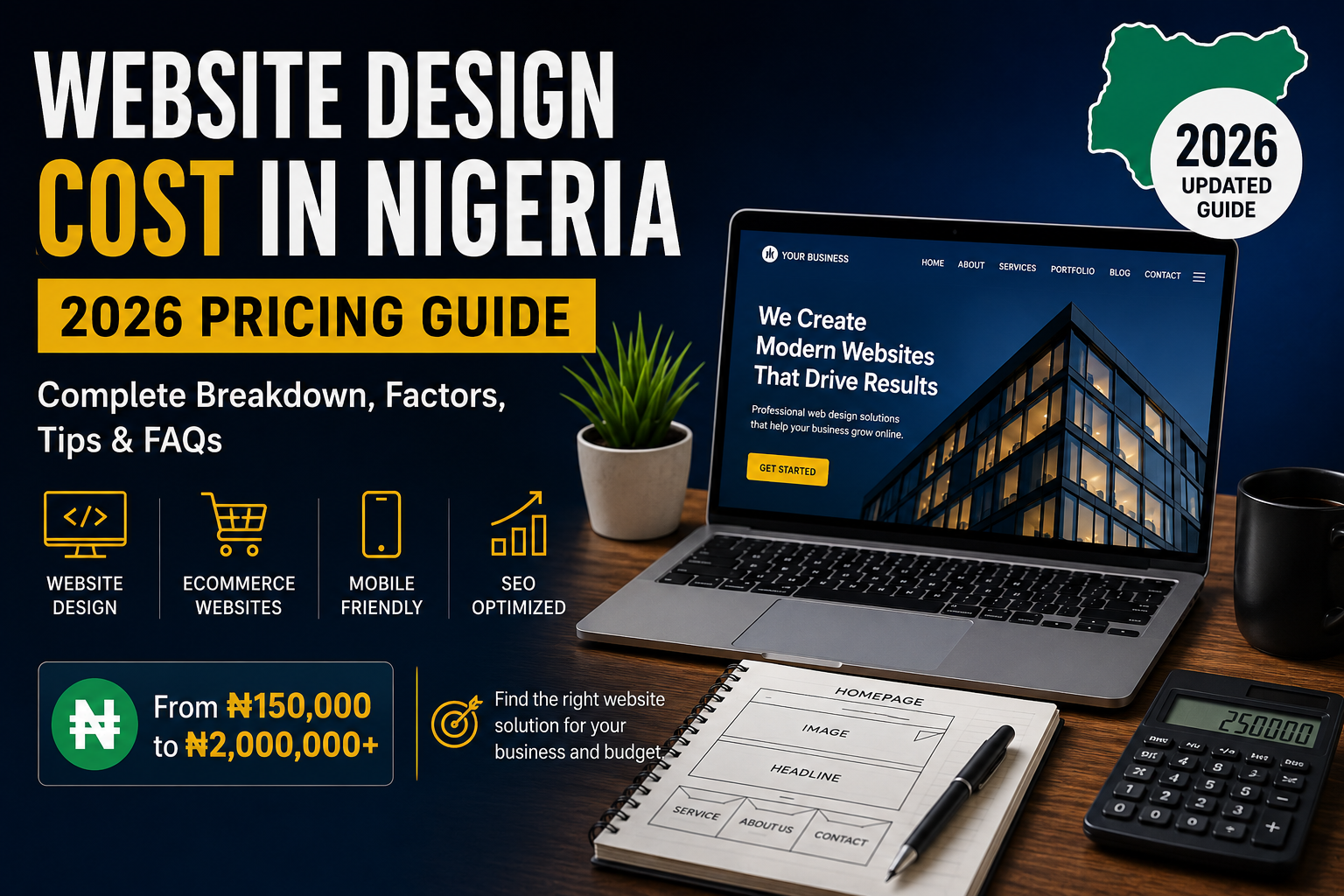
How Much Does It Cost to Build a Website in Nigeria? (2026 Complete Pricing Guide)
If you’re planning to build a website for your business, one of the first questions you’ll probably ask is:
How much does it cost to build a website in Nigeria?
The short answer is that website design costs in Nigeria typically range from ₦150,000 to over ₦2,000,000, depending on the type of website, the number of pages, required features, level of customization, and the experience of the web designer or agency you hire.
Whether you’re a startup in Lagos, a small business owner in Abuja, a church in Port Harcourt, a school in Ibadan, or an established company expanding across Nigeria, understanding the real cost of building a website helps you budget wisely and avoid expensive mistakes.
Unfortunately, many pricing guides online are either outdated, too vague, or based on international markets that don’t reflect the realities of doing business in Nigeria. Some promise a complete website for ₦30,000, while others quote millions without explaining what you’re actually paying for.
This guide is different.
Drawing from real-world experience designing websites for Nigerian businesses, we’ll break down every major cost involved—from domain registration and web hosting to website design, development, SEO, maintenance, and premium features. You’ll also learn why website prices vary so much, how to avoid hidden costs, and how to choose the right web design company for your budget.
By the end of this guide, you’ll know exactly how much it costs to create a website in Nigeria, what influences website design prices, and how to invest in a website that delivers long-term value instead of becoming an expensive liability.
Quick Answer: How Much Does It Cost to Build a Website in Nigeria?
For most businesses in Nigeria, website development costs fall within the following ranges:
| Website Type | Typical Cost |
|---|---|
| One-Page Landing Page | ₦100,000 – ₦180,000 |
| Small Business Website | ₦150,000 – ₦350,000 |
| Corporate Website | ₦250,000 – ₦700,000 |
| E-commerce Website | ₦450,000 – ₦1,500,000+ |
| School Website | ₦300,000 – ₦900,000 |
| Real Estate Website | ₦450,000 – ₦1,200,000 |
| Hospital or Clinic Website | ₦350,000 – ₦900,000 |
| Custom Web Application | ₦800,000 – ₦5,000,000+ |
These estimates generally include website design and development but may not include recurring costs such as domain registration, web hosting, premium plugins, content writing, ongoing maintenance, or digital marketing.
Why Website Design Prices in Nigeria Vary So Much
There isn’t a fixed price for building a website because no two businesses have the same requirements.
For example, a simple five-page company website with basic contact information costs significantly less than an online store with hundreds of products, payment gateways, customer accounts, inventory management, and custom integrations.
Several factors influence the total web design cost, including:
- The type of website you’re building
- The number of pages
- Custom design requirements
- Special functionality such as bookings or online payments
- Content writing and photography
- Search engine optimization (SEO)
- Domain name and hosting
- Website security
- Ongoing maintenance and support
- Whether you hire a freelancer or a professional web design agency
Understanding these factors will help you compare quotes more accurately and choose a solution that fits your business goals instead of simply selecting the lowest price.
In the following sections, we’ll break down every cost involved so you can confidently estimate the budget needed to build a professional website in Nigeria in 2026.
Average Website Design Prices in Nigeria (2026)
One of the most common questions business owners ask is, “How much does it cost to create a website in Nigeria?” While there’s no single price that applies to every project, there are industry averages that can help you set a realistic budget.
In Nigeria, website design prices typically range from ₦150,000 for a basic business website to over ₦2,000,000 for complex websites with custom functionality. The final cost depends on the size of the website, its features, level of customization, and whether you hire a freelancer or a professional web design agency.
The table below provides a general overview of website design costs in Nigeria for different types of websites.
Website Design Cost in Nigeria by Website Type
| Website Type | Typical Price Range |
|---|---|
| One-Page Landing Page | ₦100,000 – ₦180,000 |
| Small Business Website (5–10 Pages) | ₦150,000 – ₦350,000 |
| Corporate Website | ₦250,000 – ₦700,000 |
| Portfolio Website | ₦150,000 – ₦300,000 |
| Blog or News Website | ₦180,000 – ₦450,000 |
| School Website | ₦300,000 – ₦900,000 |
| Church Website | ₦250,000 – ₦700,000 |
| NGO Website | ₦250,000 – ₦700,000 |
| Hospital or Clinic Website | ₦350,000 – ₦900,000 |
| Hotel Website | ₦350,000 – ₦1,000,000 |
| Real Estate Website | ₦450,000 – ₦1,200,000 |
| Restaurant Website | ₦200,000 – ₦500,000 |
| E-commerce Website | ₦450,000 – ₦1,500,000+ |
| Membership Website | ₦500,000 – ₦1,500,000+ |
| Custom Web Application | ₦800,000 – ₦5,000,000+ |
These estimates include professional design and development but may not include additional services such as SEO, premium plugins, ongoing maintenance, content writing, branding, photography, or digital marketing.
Average Website Design Cost by Business Size
The size and maturity of your business also influence how much you’ll spend on a website. Larger organizations usually require more pages, advanced functionality, stronger security, and integrations with third-party systems.
| Business Type | Estimated Website Cost |
|---|---|
| Freelancer or Personal Brand | ₦100,000 – ₦250,000 |
| Startup | ₦150,000 – ₦400,000 |
| Small Business | ₦200,000 – ₦500,000 |
| Medium-Sized Business | ₦400,000 – ₦900,000 |
| Large Company | ₦700,000 – ₦2,000,000+ |
| Enterprise or Custom Platform | ₦2,000,000 – ₦5,000,000+ |
For many Nigerian SMEs, a professionally designed website within the ₦200,000 to ₦500,000 range provides the best balance between affordability, performance, and long-term value.
Average Web Design Fees: Freelancer vs Agency
Another major factor affecting web design fees is who you hire.
Freelancers generally charge less because they work independently and have lower operating costs. However, they may have limited capacity for larger projects and ongoing support.
Professional web design agencies typically charge more but provide access to a team of designers, developers, SEO specialists, content strategists, and project managers who work together to deliver a more polished product.
| Service Provider | Typical Cost |
|---|---|
| Beginner Freelancer | ₦80,000 – ₦180,000 |
| Experienced Freelancer | ₦150,000 – ₦500,000 |
| Small Web Design Agency | ₦250,000 – ₦800,000 |
| Established Digital Agency | ₦500,000 – ₦2,000,000+ |
If your website is a key part of your business strategy, investing in an experienced agency often delivers better long-term results through improved design, faster performance, stronger SEO, and reliable post-launch support.
Why Do Website Design Prices Differ So Much?
You may receive two quotes for the same project that differ by hundreds of thousands of naira. That doesn’t necessarily mean one is overpriced—it often reflects differences in quality, experience, and what’s included.
For example, one proposal may include:
- Custom UI/UX design
- Mobile-responsive development
- Technical SEO setup
- Speed optimization
- SSL configuration
- Contact forms and lead generation
- Security hardening
- Analytics integration
- Basic content upload
- Staff training
- One year of technical support
Another quote may only cover the website itself, leaving you to pay separately for hosting, SEO, maintenance, security, backups, premium plugins, and future updates.
When comparing quotes, don’t focus only on the price. Compare the scope of work, included features, support period, and expected outcomes. A slightly higher investment today can save you significant time, money, and frustration in the future.
What Is the Right Budget for Your Business?
If you’re launching a new business or replacing an outdated website, it’s generally better to invest in a solution that can grow with your business rather than choosing the cheapest option available.
As a practical guide:
- ₦150,000 – ₦350,000 is suitable for most startups and small businesses.
- ₦350,000 – ₦700,000 is ideal for established businesses that need stronger branding, SEO, and lead generation.
- ₦450,000 – ₦1,500,000+ is a realistic budget for professional e-commerce websites with online payments and advanced functionality.
- ₦800,000+ is appropriate for businesses requiring custom web applications, portals, booking systems, or complex integrations.
The best website isn’t necessarily the cheapest—it’s the one that helps your business attract customers, generate leads, increase sales, and deliver a measurable return on investment.
What Affects the Cost of Building a Website in Nigeria?
If you’ve requested quotations from different web designers or agencies, you’ve probably noticed that prices can vary significantly. One developer may quote ₦180,000, while another charges ₦600,000 or more for what appears to be the same website.
So, why is there such a huge difference?
The truth is that website design cost in Nigeria isn’t determined by a fixed price list. Instead, it’s influenced by several factors that affect the amount of work, expertise, and technology required to build a website that meets your business goals.
Understanding these factors will help you compare quotations fairly and avoid choosing a cheap website that ends up costing more in the long run.
1. Type of Website

The biggest factor affecting how much it costs to build a website in Nigeria is the type of website you need.
A simple informational website requires far less work than an online store or custom business platform.
For example:
| Website Type | Relative Cost |
|---|---|
| Landing Page | Low |
| Portfolio Website | Low |
| Small Business Website | Medium |
| Corporate Website | Medium |
| School Website | Medium |
| Church Website | Medium |
| Real Estate Website | High |
| Hotel Website | High |
| E-commerce Website | High |
| Membership Website | Very High |
| Custom Web Application | Premium |
A landing page may only require one page with a contact form, while an e-commerce website needs product management, online payments, shipping options, customer accounts, order tracking, and inventory management. Naturally, the second project requires considerably more time and expertise.
2. Number of Pages
The number of pages also affects your website design cost.
A website with five pages is quicker to design than one with fifty pages.
Typical business websites include pages such as:
- Home
- About Us
- Services
- Portfolio
- Contact
- Blog
- FAQ
- Testimonials
- Careers
- Privacy Policy
Larger organizations may require additional landing pages for each service, location, or product category. While these extra pages improve user experience and SEO, they also increase design, development, and content creation costs.
3. Custom Design vs Template Design
Another major factor is whether your website uses a ready-made template or a completely custom design.
Template-Based Website
A template-based website uses a professionally designed layout that is customized with your branding, colours, content, and images.
Advantages include:
- Lower cost
- Faster delivery
- Proven layouts
- Excellent for startups and small businesses
Custom Website Design
A custom website is designed from scratch to match your brand identity and business objectives.
Benefits include:
- Unique visual identity
- Better user experience
- Stronger brand perception
- Greater flexibility
- Easier future expansion
Custom websites require more research, wireframing, UI design, revisions, and development, making them more expensive than template-based websites.
4. Website Features and Functionality
Every additional feature adds development time, testing, and ongoing maintenance.
Some common features include:
| Feature | Can Increase Cost |
|---|---|
| Contact Forms | Low |
| WhatsApp Integration | Low |
| Live Chat | Low |
| Blog | Low |
| Appointment Booking | Medium |
| Online Payments | Medium |
| Customer Login | Medium |
| Membership System | High |
| Learning Management System (LMS) | High |
| Property Listings | High |
| Hotel Booking System | High |
| Multi-Vendor Marketplace | Very High |
| Custom Dashboard | Premium |
The more functionality you require, the higher the overall web design cost.
5. Content Creation
Many people assume that website design includes writing all the content. In reality, professional copywriting is often a separate service.
Content may include:
- Homepage copy
- About page
- Service descriptions
- Product descriptions
- Team profiles
- FAQs
- Blog articles
- SEO metadata
Well-written, SEO-optimized content helps your website rank higher on Google and convert more visitors into customers, making it a worthwhile investment.
6. Search Engine Optimization (SEO)
A beautiful website is only valuable if people can find it.
Basic SEO usually includes:
- Keyword research
- SEO-friendly URLs
- Meta titles and descriptions
- Image optimization
- Internal linking
- XML sitemap
- Robots.txt
- Schema markup
- Google Search Console setup
- Google Analytics integration
More advanced SEO services may include content strategy, local SEO, backlink building, technical audits, and ongoing optimization.
While SEO increases the initial cost of building a website in Nigeria, it can significantly improve your visibility on Google and generate consistent leads over time.
7. Responsive Design
Today, most Nigerians access websites using smartphones.
A professional website must work seamlessly across:
- Mobile phones
- Tablets
- Laptops
- Desktop computers
Responsive design ensures your website looks and functions correctly on every screen size.
Although responsive development requires additional testing and optimization, it’s essential for user experience and search engine rankings.
8. Website Speed and Performance
Website speed has a direct impact on user satisfaction, conversions, and Google rankings.
Optimizing a website for speed may involve:
- Image compression
- Code optimization
- Browser caching
- Lazy loading
- Content Delivery Networks (CDNs)
- High-performance hosting
- Database optimization
Fast websites often require more technical expertise but provide a much better experience for visitors.
9. Security Requirements
Security is often overlooked until something goes wrong.
Professional websites typically include:
- SSL certificates
- Firewall protection
- Malware scanning
- Secure login systems
- Automatic backups
- Security updates
- Spam protection
Businesses that collect customer information or process online payments should never compromise on website security.
10. Experience of the Web Designer or Agency
One of the biggest reasons for differences in web design fees is experience.
A beginner freelancer may charge less because they’re still building their portfolio.
An experienced web design agency charges more because you’re paying for:
- Years of experience
- Better design quality
- Proven processes
- SEO expertise
- Faster delivery
- Dedicated support
- Ongoing maintenance
- Quality assurance
- Project management
While a lower quote may seem attractive, it’s important to consider the long-term value you’ll receive.
11. Ongoing Maintenance and Support
Building the website is only the beginning.
Like any business asset, a website requires regular maintenance to remain secure, fast, and compatible with new technologies.
Maintenance services may include:
- Plugin updates
- WordPress updates
- Security monitoring
- Website backups
- Bug fixes
- Performance optimization
- Content updates
- Technical support
Some agencies include maintenance for a limited period after launch, while others offer monthly maintenance plans. Always ask what’s included before signing a contract.
Remember: You’re Investing in a Business Asset
When evaluating website design prices, it’s tempting to choose the cheapest quote. However, a website should be viewed as an investment rather than an expense.
A professionally designed website can:
- Generate qualified leads
- Increase online sales
- Build trust and credibility
- Improve customer experience
- Strengthen your brand
- Reduce manual enquiries
- Support your marketing campaigns
- Deliver returns for years with proper maintenance
Instead of asking, “What’s the cheapest website I can get?”, ask “Which website will help my business grow?” That shift in perspective often leads to a far better long-term outcome.
Complete Cost Breakdown of Building a Website in Nigeria (2025)
Now that you understand the factors that influence website design prices, let’s break down every expense involved in building a professional website in Nigeria.
Many business owners only budget for the design itself and are surprised to discover there are other essential costs, such as domain registration, web hosting, premium software, SEO, and ongoing maintenance.
The good news is that not every website needs every service. Your total investment depends on your business goals and the type of website you’re building.
Below is a detailed breakdown of each cost.
1. Domain Name Cost
A domain name is your website’s address on the internet.
For example:
- yourbusiness.com
- yourbusiness.com.ng
- yourbusiness.ng
A good domain name should be:
- Short
- Easy to remember
- Easy to spell
- Relevant to your business
- Free from numbers and unnecessary symbols
Domains are rented annually, meaning you’ll need to renew them every year to keep ownership.
Average Domain Name Prices in Nigeria

| Domain Extension | Annual Cost |
|---|---|
| .com.ng | ₦1,500 – ₦3,500 |
| .ng | ₦10,000 – ₦20,000 |
| .com | ₦18,000 – ₦30,000 |
| .org | ₦18,000 – ₦30,000 |
| .net | ₦20,000 – ₦35,000 |
Which Domain Extension Should You Choose?
.com.ng
Ideal for businesses that primarily serve customers within Nigeria. It’s affordable, trusted locally, and great for startups and SMEs.
.com
The most recognized domain extension worldwide. It’s recommended if you plan to target customers outside Nigeria or build a globally recognized brand.
.ng
A premium Nigerian domain that offers strong local branding and is becoming increasingly popular among established businesses.
Pro Tip: Register your domain under your own name or company account—not your developer’s. This ensures you retain ownership even if you switch agencies in the future.
2. Web Hosting Cost
Web hosting is the service that stores your website files and makes them accessible to visitors 24 hours a day.
Without hosting, your website cannot be viewed online.
The quality of your hosting directly affects:
- Website speed
- Security
- Uptime
- SEO performance
- User experience
Choosing cheap hosting may save money initially but often results in slow loading times, frequent downtime, and poor customer experience.
Typical Hosting Costs in Nigeria
| Hosting Type | Annual Cost | Best For |
|---|---|---|
| Shared Hosting | ₦15,000 – ₦40,000 | Small business websites |
| Business Hosting | ₦30,000 – ₦80,000 | Growing businesses |
| Cloud Hosting | ₦60,000 – ₦180,000 | High-performance websites |
| VPS Hosting | ₦120,000 – ₦400,000 | Large businesses & eCommerce |
| Dedicated Server | ₦500,000+ | Enterprise applications |
Shared Hosting
Suitable for startups and businesses with relatively low website traffic.
Cloud Hosting
Provides better speed, improved reliability, and the ability to handle traffic spikes.
VPS Hosting
Offers dedicated resources, making it ideal for busy eCommerce stores and business-critical websites.
See Our Compete blog on the best hosting companies in Nigeria
3. SSL Certificate Cost
An SSL certificate encrypts information sent between your website and its visitors.
You’ll recognize it by the padlock icon next to your website address.
SSL is important because it:
- Protects customer information
- Builds trust
- Improves SEO
- Is required for online payments
SSL Pricing
| SSL Type | Annual Cost |
|---|---|
| Let’s Encrypt | Free |
| Standard SSL | ₦15,000 – ₦40,000 |
| Premium SSL | ₦40,000 – ₦150,000+ |
For most small and medium-sized businesses, a free SSL certificate is more than sufficient.
4. Website Design Cost
Website design focuses on how your website looks and how visitors interact with it.
Good design goes beyond attractive colours and images. It creates a smooth experience that encourages visitors to take action.
Professional website design includes:
- Brand colours
- Typography
- User interface (UI)
- User experience (UX)
- Mobile responsiveness
- Conversion-focused layouts
- Accessibility considerations
Average Website Design Prices
| Design Type | Estimated Cost |
|---|---|
| Template Customization | ₦80,000 – ₦180,000 |
| Semi-Custom Design | ₦180,000 – ₦400,000 |
| Fully Custom Design | ₦400,000 – ₦1,200,000+ |
A custom design is generally recommended for businesses looking to stand out in competitive markets.
5. Website Development Cost
Development is the process of turning the approved design into a fully functional website.
This includes:
- Building pages
- Adding animations
- Creating forms
- Integrating payment gateways
- Optimizing performance
- Testing across devices
Typical Website Development Cost
| Website Type | Development Cost |
|---|---|
| Landing Page | ₦100,000 – ₦180,000 |
| Small Business Website | ₦150,000 – ₦350,000 |
| Corporate Website | ₦250,000 – ₦700,000 |
| E-commerce Website | ₦450,000 – ₦1,500,000+ |
| Custom Platform | ₦800,000 – ₦5,000,000+ |
Development costs increase as more custom features and integrations are required.
6. Premium Themes and Plugins
Many modern websites rely on premium software to provide advanced functionality.
Examples include:
- SEO tools
- Contact forms
- Booking systems
- Security plugins
- Page builders
- Membership platforms
- E-learning systems
Typical Plugin Costs
| Plugin Category | Annual Cost |
|---|---|
| SEO Plugin | ₦30,000 – ₦80,000 |
| Premium Theme | ₦25,000 – ₦80,000 |
| Page Builder | ₦40,000 – ₦90,000 |
| Booking Plugin | ₦50,000 – ₦200,000 |
| Membership Plugin | ₦80,000 – ₦250,000 |
Not every website requires premium plugins, but they can significantly improve functionality and save development time.
7. Content Writing Cost
Your website is only as effective as the words on it.
Professional copywriting helps visitors understand your business and encourages them to take action.
Content may include:
- Homepage
- About page
- Services
- Product descriptions
- FAQs
- Blog articles
- Calls-to-action
Average Copywriting Cost
| Content Type | Estimated Cost |
|---|---|
| Per Page | ₦15,000 – ₦50,000 |
| SEO Landing Page | ₦25,000 – ₦80,000 |
| Complete Small Website | ₦80,000 – ₦300,000 |
Well-written content also improves your chances of ranking on Google for relevant search terms.
8. Search Engine Optimization (SEO)
A website without SEO is like opening a beautiful shop on a street where nobody passes.
SEO helps your website appear in search results when potential customers search for your products or services.
Basic SEO generally includes:
- Keyword research
- Meta titles
- Meta descriptions
- Technical SEO
- Internal linking
- Image optimization
- XML sitemap
- Google Search Console setup
SEO Cost in Nigeria
| SEO Service | Typical Cost |
|---|---|
| Basic Website SEO | ₦50,000 – ₦150,000 |
| Local SEO | ₦100,000 – ₦300,000 |
| Comprehensive SEO Campaign | ₦250,000 – ₦1,000,000+ |
Investing in SEO from the beginning is often more cost-effective than trying to fix SEO issues after your website has launched.
9. Website Maintenance Cost
Launching your website isn’t the end of the journey.
To keep your website secure, fast, and functioning properly, regular maintenance is essential.
Maintenance typically includes:
- Software updates
- Security patches
- Daily or weekly backups
- Malware scanning
- Speed optimization
- Bug fixes
- Technical support
Monthly Website Maintenance Cost
| Service Level | Monthly Cost |
|---|---|
| Basic Maintenance | ₦10,000 – ₦25,000 |
| Standard Maintenance | ₦25,000 – ₦60,000 |
| Premium Support | ₦60,000 – ₦150,000+ |
Many agencies offer discounted maintenance plans for websites they build.
10. Additional Costs You Should Budget For
Depending on your business, you may also need:
| Service | Estimated Cost |
|---|---|
| Professional Photography | ₦50,000 – ₦300,000 |
| Logo Design | ₦50,000 – ₦250,000 |
| Brand Identity | ₦150,000 – ₦800,000 |
| Business Email Setup | ₦15,000 – ₦80,000/year |
| Product Upload | ₦200 – ₦1,000 per product |
| Google Business Profile Setup | ₦50,000 – ₦150,000 |
| Email Marketing Integration | ₦50,000 – ₦200,000 |
| Live Chat Integration | ₦20,000 – ₦80,000 |
While these services are optional, they can significantly improve your website’s professionalism, visibility, and ability to generate leads.
Total Cost of Building a Website in Nigeria
When all the essential components are considered, the total cost of building a website in Nigeria depends largely on your business needs.
Here’s a realistic estimate:
| Website Type | Total Estimated Cost |
|---|---|
| Landing Page | ₦100,000 – ₦180,000 |
| Small Business Website | ₦150,000 – ₦350,000 |
| Corporate Website | ₦250,000 – ₦700,000 |
| School Website | ₦300,000 – ₦900,000 |
| Hotel Website | ₦350,000 – ₦1,000,000 |
| Real Estate Website | ₦450,000 – ₦1,200,000 |
| E-commerce Website | ₦450,000 – ₦1,500,000+ |
| Custom Web Application | ₦800,000 – ₦5,000,000+ |
While it may be tempting to choose the lowest quote, it’s important to consider the quality of the work, the experience of the developer, and the long-term value the website will provide. A professionally built website can become one of your most valuable business assets, generating leads and sales for years to come.
Website Design Cost in Nigeria by Website Type (2026)
One of the biggest factors that determines how much it costs to build a website in Nigeria is the type of website you need. A simple portfolio website requires far less time and functionality than an eCommerce store, booking platform, or custom web application.
Below is a breakdown of the average website design prices in Nigeria based on different website types.
1. Landing Page Website Cost
Estimated Cost: ₦100,000 – ₦180,000
A landing page is a single-page website designed to achieve one specific goal, such as generating leads, promoting a product, collecting enquiries, or encouraging visitors to book a consultation.
Landing pages are popular among:
- Startups
- Event organizers
- Real estate agents
- Coaches and consultants
- Marketing campaigns
- Product launches
A typical landing page includes:
- Hero section
- Benefits or features
- About section
- Testimonials
- Frequently Asked Questions
- Call-to-action buttons
- Contact form
- WhatsApp integration
If your primary objective is lead generation rather than providing lots of information, a landing page can be a cost-effective starting point.
2. Small Business Website Cost
Estimated Cost: ₦150,000 – ₦350,000
A small business website is one of the most common projects requested by Nigerian businesses.
It’s ideal for:
- Small businesses
- Service providers
- Agencies
- Restaurants
- Salons
- Logistics companies
- Cleaning companies
- Construction firms
Most small business websites include:
- Home
- About Us
- Services
- Portfolio or Gallery
- Testimonials
- FAQ
- Contact Page
Depending on your requirements, additional pages can be added for blog posts, pricing, careers, or individual services.
For many businesses, this type of website offers the best balance between affordability and functionality.
3. Corporate Website Cost
Estimated Cost: ₦250,000 – ₦700,000
Corporate websites are designed for established companies that want to project professionalism, build credibility, and generate enquiries.
They usually feature:
- Professional custom design
- Company profile
- Multiple service pages
- Team profiles
- Career page
- Investor or company information
- News or blog section
- Contact forms
- Downloadable brochures
- Interactive maps
Corporate websites often require stronger branding, better user experience, advanced security, and more extensive SEO than smaller websites.
4. Portfolio Website Cost
Estimated Cost: ₦150,000 – ₦300,000
Portfolio websites are designed to showcase work, experience, and achievements.
They are ideal for:
- Photographers
- Designers
- Architects
- Developers
- Writers
- Artists
- Consultants
- Creative agencies
Typical features include:
- Portfolio gallery
- Case studies
- About page
- Services
- Testimonials
- Contact page
- Blog (optional)
A well-designed portfolio website helps establish trust and demonstrate expertise to potential clients.
5. Blog or News Website Cost
Estimated Cost: ₦180,000 – ₦450,000
Blog and news websites focus on publishing content regularly.
These websites typically include:
- Blog categories
- Author profiles
- Search functionality
- Related articles
- Comment systems
- Newsletter signup
- Social sharing
- Advertisement placements
Because content is the primary focus, performance, readability, and SEO are especially important.
6. Church Website Cost
Estimated Cost: ₦250,000 – ₦700,000
Churches increasingly rely on websites to communicate with members, livestream services, and accept online donations.
Common features include:
- Sermon archive
- Livestream integration
- Online giving
- Ministries
- Events calendar
- Prayer request forms
- Photo gallery
- Blog
- Contact information
Additional custom functionality may increase the overall project cost.
7. School Website Cost
Estimated Cost: ₦300,000 – ₦900,000
Schools require websites that provide information to parents, students, and prospective families.
Features often include:
- Admission information
- Academic calendar
- News and announcements
- Staff profiles
- Gallery
- Download centre
- Online enquiry forms
Schools requiring student portals, online learning systems, or result-checking platforms should budget considerably more.
8. Hospital or Clinic Website Cost
Estimated Cost: ₦350,000 – ₦900,000
Healthcare websites require a professional design that builds confidence and makes it easy for patients to access information.
Typical features include:
- Doctor profiles
- Medical services
- Appointment booking
- Health blog
- Insurance information
- Emergency contacts
- Location map
Hospitals handling patient records or secure medical data may require additional security measures and compliance considerations.
9. Real Estate Website Cost
Estimated Cost: ₦450,000 – ₦1,200,000
Real estate websites are more complex than standard business websites because they manage property listings and search functionality.
Common features include:
- Property listings
- Advanced search filters
- Interactive maps
- Property galleries
- Virtual tours
- Agent profiles
- Mortgage calculator
- Contact forms
- Property enquiry system
Larger agencies with hundreds of listings may require custom integrations with property management software.
10. Hotel Website Cost
Estimated Cost: ₦350,000 – ₦1,000,000
Hotels require websites that help guests explore rooms and make reservations.
Popular features include:
- Room listings
- Online booking
- Photo galleries
- Restaurant menus
- Events
- Contact information
- Google Maps
- Customer reviews
If direct booking functionality is included, the cost is generally higher than a standard corporate website.
11. E-commerce Website Cost
Estimated Cost: ₦450,000 – ₦1,500,000+
An eCommerce website allows customers to purchase products online.
Because of its complexity, it’s one of the most expensive website types.
Typical features include:
- Product catalogue
- Shopping cart
- Secure checkout
- Paystack integration
- Flutterwave integration
- Inventory management
- Shipping options
- Customer accounts
- Wishlist
- Coupons and discounts
- Order tracking
- Product reviews
The more products, categories, and custom features your store requires, the higher the development cost.
12. Membership Website Cost
Estimated Cost: ₦500,000 – ₦1,500,000+
Membership websites restrict content to registered users.
They are commonly used for:
- Online communities
- Premium content
- Coaching programmes
- Online courses
- Professional associations
Features often include:
- User registration
- Login system
- Subscription payments
- Member dashboard
- Protected content
- Email automation
- Community forums
13. Custom Web Application Cost
Estimated Cost: ₦800,000 – ₦5,000,000+
Custom web applications are built specifically around unique business processes.
Examples include:
- Logistics management systems
- Hospital management systems
- School portals
- HR systems
- CRM software
- Inventory management platforms
- Booking platforms
- Marketplace websites
- SaaS applications
These projects involve planning, database architecture, custom development, testing, and long-term support, making them the most expensive type of website to build.
Website Cost Comparison at a Glance
| Website Type | Average Cost |
|---|---|
| Landing Page | ₦100,000 – ₦180,000 |
| Portfolio Website | ₦150,000 – ₦300,000 |
| Small Business Website | ₦150,000 – ₦350,000 |
| Blog Website | ₦180,000 – ₦450,000 |
| Corporate Website | ₦250,000 – ₦700,000 |
| Church Website | ₦250,000 – ₦700,000 |
| School Website | ₦300,000 – ₦900,000 |
| Hospital Website | ₦350,000 – ₦900,000 |
| Hotel Website | ₦350,000 – ₦1,000,000 |
| Real Estate Website | ₦450,000 – ₦1,200,000 |
| E-commerce Website | ₦450,000 – ₦1,500,000+ |
| Membership Website | ₦500,000 – ₦1,500,000+ |
| Custom Web Application | ₦800,000 – ₦5,000,000+ |
Which Website Is Right for Your Business?
Choosing the right type of website isn’t just about budget—it’s about selecting a solution that aligns with your business goals. A small service-based business may only need a professional corporate website to generate leads, while a retailer may require a feature-rich eCommerce platform capable of processing online orders.
If you’re unsure which option suits your business, start by identifying what you want your website to achieve over the next three to five years. Building with future growth in mind can save you the cost of a complete redesign later.
Freelancer vs Web Design Agency in Nigeria: Which Offers Better Value?
One of the biggest decisions you’ll make when building a website is who should build it.
Should you hire a freelancer because they’re cheaper, or should you invest in a professional web design agency?
There’s no universal right answer. The best choice depends on your budget, project complexity, business goals, and the level of support you expect after your website goes live.
While freelancers and agencies can both build excellent websites, there are significant differences in pricing, expertise, communication, and long-term value.
Freelancer vs Agency Comparison
| Factor | Freelancer | Web Design Agency |
|---|---|---|
| Typical Cost | ₦150,000 – ₦500,000 | ₦250,000 – ₦2,000,000+ |
| Team Size | One person | Designers, developers, SEO specialists, project managers |
| Project Speed | Depends on workload | Faster for larger projects due to team collaboration |
| Design Quality | Varies by experience | More consistent quality standards |
| SEO Expertise | May be limited | Usually included or available as an additional service |
| Support | Limited availability | Dedicated post-launch support |
| Scalability | Better for smaller projects | Better for growing businesses and complex websites |
| Maintenance | Often optional | Structured maintenance plans available |
| Reliability | Depends on the individual | Established processes and service agreements |
When a Freelancer Is the Right Choice
Hiring a freelancer can be a smart decision if your project is relatively simple and your budget is limited.
A freelancer may be ideal if you need:
- A personal portfolio website
- A simple landing page
- A small business website
- Minor website updates
- Basic WordPress customization
Experienced freelancers often deliver excellent work at competitive prices because they have fewer overhead costs than agencies.
However, before hiring a freelancer, it’s important to review:
- Their portfolio
- Previous client testimonials
- Communication style
- Delivery timelines
- Post-launch support
The quality of freelancers varies significantly, so taking time to evaluate their experience can help you avoid costly mistakes.
When a Web Design Agency Is the Better Investment
For businesses that depend on their website to generate leads or sales, working with a professional agency often provides greater long-term value.
A web design agency is usually the better choice if you need:
- A custom website
- An eCommerce store
- SEO-focused website development
- A booking or appointment system
- Ongoing maintenance and support
- Branding and content writing
- Long-term digital marketing
Instead of relying on one individual, agencies provide access to specialists with expertise in different areas of web design and digital marketing.
This collaborative approach often results in a website that’s more polished, faster, more secure, and better optimized for search engines.
Why Do Agencies Charge More?
Many business owners wonder why one agency quotes ₦300,000 while another charges ₦900,000 or more for what appears to be a similar website.
The answer lies in what’s included.
A professional agency isn’t just building web pages—it’s delivering a complete digital solution designed to help your business grow.
Higher-priced website projects often include:
- Discovery and strategy sessions
- Competitor research
- Custom UI/UX design
- Responsive development
- Technical SEO setup
- Speed optimization
- Security configuration
- Browser and device testing
- Content formatting
- Analytics integration
- Staff training
- Quality assurance
- Ongoing technical support
These services require additional time, expertise, and resources, but they often result in a website that performs better and lasts longer.
The Hidden Cost of Choosing the Cheapest Option
Choosing the lowest quote can seem like a good financial decision, but it often leads to higher costs later.
Some low-cost websites suffer from issues such as:
- Slow loading speeds
- Poor mobile responsiveness
- Weak security
- Outdated design
- Poor search engine optimization
- Difficult content management
- Limited scalability
- No documentation
- No post-launch support
As a result, many businesses end up paying for a complete redesign within a year or two—effectively paying twice for the same project.
A well-built website may cost more initially, but it can save money over the long term by reducing maintenance issues, improving conversions, and supporting future growth.
Questions to Ask Before Hiring a Web Designer
Whether you choose a freelancer or an agency, don’t make your decision based on price alone.
Ask questions such as:
- Can I see examples of similar websites you’ve built?
- What’s included in the quoted price?
- Is SEO included?
- Is the website mobile responsive?
- Who owns the website after it’s completed?
- Will I have access to the hosting and domain account?
- Is training provided?
- What happens if I need changes after launch?
- Do you offer maintenance plans?
- How long will the project take?
The answers to these questions will help you compare proposals more accurately and avoid misunderstandings later.
Which Option Offers Better Value?
If your goal is simply to establish an online presence with a basic website, an experienced freelancer may provide excellent value.
However, if your website is expected to generate leads, process online payments, support marketing campaigns, or represent an established brand, investing in a reputable web design agency is often the smarter long-term decision.
Rather than focusing solely on website design cost, consider the overall return on your investment.
A professionally designed website should:
- Build trust with potential customers
- Generate enquiries and sales
- Improve your visibility on Google
- Strengthen your brand image
- Save time through automation
- Support your business for years to come
The cheapest website isn’t always the most affordable. The best value comes from a website that helps your business achieve its goals while providing reliable support, security, and room to grow.
Hidden Website Costs Most Nigerian Businesses Don’t Budget For
When planning a website, many business owners focus only on the design and development fee. However, building the website is just one part of the overall investment.
There are several ongoing and optional costs that can affect your total budget over time. Understanding these expenses before your project begins will help you avoid surprises and make better financial decisions.
The good news is that many of these costs are predictable and can be planned for in advance.
1. Domain Name Renewal
Your domain name isn’t a one-time purchase.
It’s rented on a yearly basis and must be renewed before it expires.
If you forget to renew your domain:
- Your website may go offline.
- Your business email addresses may stop working.
- Someone else could register your domain if it becomes available.
Depending on the extension you choose, annual renewal fees typically range from ₦1,500 to ₦30,000.
Tip: Enable automatic renewal or set reminders so you never lose your domain name.
2. Web Hosting Renewal
Just like your domain, web hosting is an annual or monthly recurring expense.
As your business grows, you may also need to upgrade your hosting plan to support:
- More visitors
- Faster loading speeds
- Additional storage
- Better security
- Higher uptime
While basic hosting may cost ₦15,000–₦40,000 per year, larger websites and online stores often require more powerful hosting solutions.
3. Website Maintenance
A website should never be left unattended after launch.
Regular maintenance helps keep it secure, compatible, and performing at its best.
Maintenance usually includes:
- WordPress updates
- Plugin updates
- Theme updates
- Security monitoring
- Malware removal
- Regular backups
- Performance optimization
- Bug fixes
Skipping maintenance can lead to security vulnerabilities, broken functionality, slower performance, and unexpected downtime.
Many agencies offer maintenance plans ranging from ₦10,000 to ₦150,000 per month, depending on the level of support required.
4. Premium Plugin and Software Renewals
Many websites rely on premium software for advanced functionality.
Examples include:
- SEO tools
- Page builders
- Booking systems
- Membership platforms
- Security plugins
- Backup software
- Form builders
These licenses are often billed annually.
If they’re not renewed:
- You may stop receiving updates.
- Security patches may no longer be available.
- Technical support may end.
- Some premium features may stop working.
Always ask your web designer which software requires annual renewal.
5. Content Updates
Businesses evolve over time.
You might need to update:
- Staff information
- Service pages
- Pricing
- Product catalogues
- Blog posts
- Portfolio projects
- Company policies
- Contact information
Some business owners handle these updates themselves, while others hire their web designer for ongoing content management.
If frequent updates are expected, it’s worth discussing maintenance packages before launching your website.
6. Search Engine Optimization (SEO)
Launching a website doesn’t automatically bring visitors.
If you want to rank on Google for competitive keywords, ongoing SEO is often necessary.
SEO services may include:
- Keyword research
- Blog writing
- Technical optimization
- Link building
- Local SEO
- Competitor analysis
- Content updates
- Performance monitoring
Many Nigerian businesses invest in monthly SEO after their website launches to continue growing their online visibility.
7. Professional Photography and Video
High-quality visuals can significantly improve the appearance and credibility of your website.
Many businesses eventually invest in:
- Team photography
- Office photography
- Product photography
- Promotional videos
- Drone footage
While stock photos are suitable for some projects, original visuals often create a stronger brand impression and improve customer trust.
8. Business Email Hosting
Professional email addresses such as:
look far more credible than free Gmail or Yahoo addresses.
Business email services may include:
- Spam protection
- Cloud storage
- Shared calendars
- Team collaboration
- Enhanced security
Depending on the provider, this can be an additional yearly or monthly expense.
9. Digital Marketing
Many businesses assume their website alone will generate customers.
In reality, most successful websites are supported by ongoing marketing activities such as:
- Google Ads
- Facebook Ads
- Instagram Ads
- Email marketing
- Content marketing
- Search engine optimization
- Social media management
Your website serves as the foundation of your online marketing, but attracting visitors often requires additional investment.
10. Website Redesign
Technology and design trends change over time.
Most professional business websites are redesigned every 3–5 years to improve:
- User experience
- Mobile responsiveness
- Website speed
- Branding
- Security
- SEO performance
Planning for future improvements helps ensure your website remains competitive as your business grows.
Common Hidden Costs at a Glance
| Expense | Frequency | Estimated Cost |
|---|---|---|
| Domain Renewal | Yearly | ₦1,500 – ₦30,000 |
| Hosting Renewal | Yearly | ₦15,000 – ₦400,000+ |
| Website Maintenance | Monthly | ₦10,000 – ₦150,000 |
| Premium Plugin Renewals | Yearly | ₦20,000 – ₦250,000+ |
| Business Email | Monthly/Yearly | ₦15,000 – ₦100,000 |
| SEO Services | Monthly | ₦100,000 – ₦1,000,000+ |
| Content Updates | As Needed | Varies |
| Photography & Video | One-off | ₦50,000 – ₦500,000+ |
| Website Redesign | Every 3–5 Years | Depends on project scope |
How to Avoid Unexpected Website Expenses
One of the best ways to avoid hidden costs is to ask detailed questions before signing a contract with a freelancer or web design agency.
Before your project begins, ask:
- Does the quoted price include domain registration and hosting?
- Are premium plugins included, and who pays for renewals?
- Is website maintenance included after launch?
- How long is free technical support available?
- Will I receive training to update the website myself?
- Are future content updates included?
- What happens if I need new features later?
- Are there any recurring fees I should expect?
A transparent web designer will explain every cost upfront and provide a clear proposal outlining what’s included and what isn’t.
Think Beyond the Initial Price
When comparing website design prices in Nigeria, don’t focus only on the upfront cost.
A website that costs ₦250,000 but requires frequent repairs, poor-quality hosting, or an expensive redesign within a year may ultimately cost more than a professionally built website that performs reliably for years.
The best investment isn’t necessarily the cheapest website—it’s the one that offers long-term value, reliable support, strong performance, and the flexibility to grow alongside your business.
How to Reduce Website Design Costs Without Compromising Quality
Every business wants a professional website, but not every business has an unlimited budget. The good news is that reducing your website design cost doesn’t have to mean settling for a poor-quality website.
With the right strategy, you can significantly lower the cost of building a website in Nigeria while still getting a fast, secure, and professional website that helps your business grow.
Here are some practical ways to get the best value for your investment.
1. Clearly Define Your Goals Before Hiring a Web Designer
One of the biggest reasons website projects become expensive is changing requirements after development has started.
Before requesting a quote, ask yourself:
- What is the purpose of the website?
- Do I want to generate leads, sell products, or build brand awareness?
- Who is my target audience?
- What features do I actually need?
- What features can wait until later?
The clearer your project scope, the more accurate your quote will be and the less likely you are to pay for unnecessary revisions.
2. Start with the Features You Actually Need
Many businesses try to build their “dream website” from day one.
While it’s good to think long-term, you don’t have to launch with every possible feature.
For example, you can start with:
- A professional homepage
- Service pages
- About page
- Contact page
- WhatsApp integration
- Blog
- Basic SEO
Then add advanced features later, such as:
- Online booking
- Customer portal
- Live chat
- Membership area
- Online courses
- Mobile app integration
- CRM integration
Launching with a Minimum Viable Website (MVW) allows you to establish your online presence while spreading costs over time.
3. Prepare Your Content in Advance
Many web design projects are delayed because clients haven’t prepared their content.
If you can provide:
- Company information
- Service descriptions
- Team profiles
- Frequently Asked Questions
- Images
- Logo
- Contact details
before development begins, you’ll reduce delays and avoid paying additional content creation fees.
If you aren’t confident writing website copy, consider hiring an SEO copywriter for your most important pages first and expanding later.
4. Use Professional Templates Where Appropriate
Not every business requires a completely custom website.
High-quality premium templates can provide:
- Modern layouts
- Mobile responsiveness
- Fast loading speeds
- Professional appearance
- Lower development costs
For startups and small businesses, a professionally customized template often delivers excellent value without sacrificing quality.
As your business grows, you can always invest in a fully custom design.
5. Invest in Quality Hosting from the Beginning
Choosing the cheapest hosting provider may save money initially, but it often leads to:
- Slow website speeds
- Frequent downtime
- Security issues
- Poor customer experience
- Lower Google rankings
Reliable hosting is one of the best investments you can make because it affects both performance and long-term maintenance costs.
A fast website also improves user satisfaction and can increase conversions.
6. Choose a Scalable Website Platform
Your website should be able to grow with your business.
A scalable platform allows you to add new features later without rebuilding the entire website.
For example, you may initially need only:
- A company profile
- Contact forms
- Service pages
Later, you may decide to add:
- Online payments
- Appointment booking
- Customer accounts
- Online courses
- E-commerce functionality
Planning for future growth now can save hundreds of thousands of naira later.
7. Don’t Choose a Web Designer Based on Price Alone
It’s tempting to accept the lowest quotation, especially when working within a limited budget.
However, extremely cheap websites often come with hidden compromises, including:
- Poor coding standards
- Outdated design
- Weak SEO
- Slow loading speeds
- Limited security
- No documentation
- Little or no post-launch support
Instead of asking, “Who is the cheapest?”, ask:
- Who understands my business?
- Who has relevant experience?
- Who communicates clearly?
- Who offers ongoing support?
- Who has a strong portfolio?
The goal is to maximize value—not simply minimize cost.
8. Request a Detailed Proposal
A professional proposal should clearly outline:
- What’s included
- What’s excluded
- Project timeline
- Payment schedule
- Number of revisions
- Support period
- Maintenance options
- Ownership of the website
- Domain and hosting details
This transparency helps you compare different quotations fairly and reduces the risk of unexpected costs later.
9. Think Long-Term, Not Short-Term
A professionally built website should serve your business for years.
Choosing higher-quality design, better hosting, and proper SEO from the beginning often reduces future expenses by minimizing redesigns, fixing fewer technical issues, and improving your website’s ability to attract customers.
Rather than focusing only on the upfront website design cost, consider the long-term return on your investment.
10. Compare More Than One Quote
Before making a decision, it’s a good idea to request proposals from at least two or three reputable web designers or agencies.
When comparing quotes, don’t look only at the final price.
Compare:
- Experience
- Portfolio
- Scope of work
- SEO services
- Support period
- Maintenance
- Timeline
- Communication
- Client reviews
A slightly higher quote may include services that would otherwise cost much more if purchased separately.
Cheap Websites vs Valuable Websites
One of the biggest misconceptions is that every website should cost as little as possible.
The reality is that a website is a business investment—not just an expense.
A professionally designed website can help you:
- Generate qualified leads
- Increase online sales
- Build customer trust
- Improve your Google rankings
- Reduce manual enquiries
- Strengthen your brand
- Support your marketing campaigns
If your website helps you win just one new client worth ₦500,000, the investment may pay for itself many times over.
Instead of asking:
“How can I build the cheapest website?”
Ask:
“How can I build the website that will generate the highest return for my business?”
That simple shift in mindset often leads to better decisions and better business outcomes.
Final Tips Before You Start Your Website Project
Before hiring a web designer, take a few minutes to:
- Define your business goals.
- Set a realistic budget.
- Prioritize essential features.
- Gather your content and branding materials.
- Compare multiple proposals.
- Ask questions about ongoing costs.
- Review previous work and testimonials.
- Choose a partner you can trust—not just the lowest bidder.
By following these steps, you’ll not only reduce the cost of creating a website, but you’ll also increase the chances of launching a website that delivers real business results for years to come.
Frequently Asked Questions About Website Design Costs in Nigeria (2025)
If you’re still wondering how much it costs to build a website in Nigeria, you’re not alone. Below are answers to the most common questions business owners ask before investing in a professional website.
How much does it cost to build a website in Nigeria?
The cost of building a website in Nigeria typically ranges from ₦150,000 to over ₦2,000,000, depending on the type of website, the number of pages, custom features, integrations, and the experience of the freelancer or agency you hire.
A basic business website usually costs ₦150,000–₦350,000, while an eCommerce website can range from ₦450,000 to ₦1,500,000 or more.What is the average website design cost in Nigeria?
For most small and medium-sized businesses, the average website design cost falls between ₦200,000 and ₦500,000.
This budget typically covers:
Custom homepage
About page
Service pages
Contact page
Mobile responsiveness
Basic on-page SEO
Contact forms
WhatsApp integration
Additional features such as online booking, payment gateways, or membership systems will increase the overall cost.How much does it cost to create a website for a small business?
A professionally designed small business website usually costs between ₦150,000 and ₦350,000.
This is suitable for businesses that need to showcase their services, generate enquiries, and establish credibility online.How much does an eCommerce website cost in Nigeria?
An eCommerce website typically costs between ₦450,000 and ₦1,500,000+.
The final cost depends on:
Number of products
Payment gateway integration
Shipping options
Inventory management
Customer accounts
Product variations
Custom functionality
Larger online stores with advanced features generally require a higher budget.How much does domain registration cost in Nigeria?
Domain registration depends on the extension you choose.
Typical annual prices include:
.com.ng: ₦1,500–₦3,500
.ng: ₦10,000–₦20,000
.com: ₦18,000–₦30,000
These fees are renewed annually.How much does web hosting cost in Nigeria?
Reliable web hosting generally costs between ₦15,000 and ₦180,000 per year.
Basic shared hosting is suitable for most small business websites, while larger websites and online stores often require cloud or VPS hosting for better performance.How long does it take to build a website?
Project timelines vary depending on the complexity of the website.
Typical timelines are:
Website Type
Estimated Timeline
Landing Page
3–7 days
Small Business Website
2–4 weeks
Corporate Website
3–6 weeks
ECommerce Website
4–8 weeks
Custom Web Application
2–6 months
Providing your content, images, and feedback on time can help keep your project on schedule.How much does website maintenance cost?
Website maintenance typically costs between ₦10,000 and ₦150,000 per month, depending on the services included.
Maintenance plans often cover:
Updates
Backups
Security monitoring
Performance optimization
Technical support